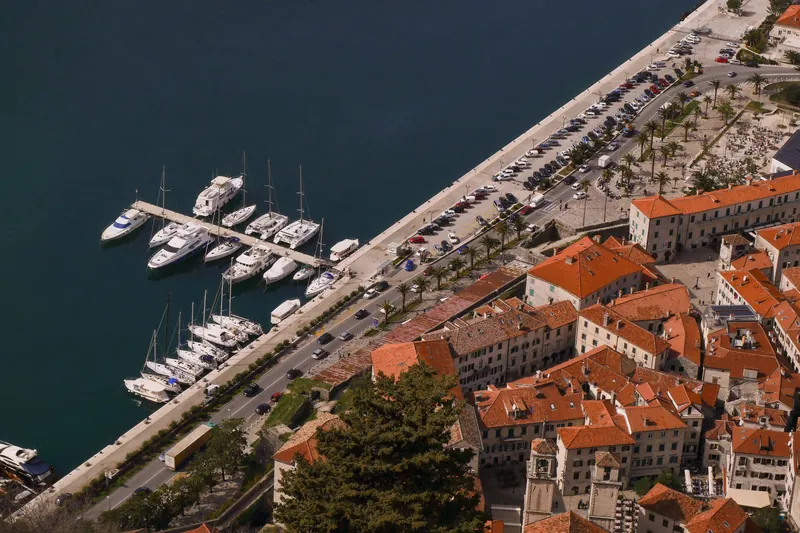


Kotor Old Town is a small walled medieval town in the innermost corner of the Bay of Kotor, where the mountains drop almost straight into the sea. Its marble-paved lanes, Romanesque churches and Venetian palaces fit inside a triangle you can cross on foot in ten minutes, yet people who come for an hour often stay the whole day.
The town sits at the foot of the Lovćen massif, and its defensive walls climb the cliff behind it in a long zigzag to the fortress of St John. From the top you look down on terracotta roofs, the curve of the bay and, on many summer days, a cruise ship that seems far too big for the water.
From Tivat Airport it is roughly a quarter of an hour by car, an easy first afternoon in Montenegro.
A short history of Kotor
People have lived at this sheltered spot since antiquity, and by the early Middle Ages Kotor (Cattaro to the Italians) was a busy trading port. The Cathedral of St Tryphon, the town’s patron saint, was consecrated in 1166 and still anchors the old town. According to local tradition, the saint’s relics were brought here by sailors in the 9th century, and the town’s seafaring brotherhood, the Boka Navy, traces its roots back to that time.
Over the Middle Ages Kotor answered to Serbian and then Hungarian kings, but it was the Republic of Venice that left the deepest mark. The town placed itself under Venetian protection in 1420 and stayed Venetian until the Republic fell in 1797. The walls, the Sea Gate with its winged lion of St Mark and many of the palaces you’ll walk past date from those centuries, when Kotor was one of Venice’s outposts facing the Ottoman Empire, whose territory began only a few kilometres away.
After Venice came short spells of Austrian and French rule, then a century under Austria-Hungary, before Kotor became part of Yugoslavia and, in 2006, of independent Montenegro. A strong earthquake in April 1979 damaged much of the old town. The same year UNESCO added the Natural and Culturo-Historical Region of Kotor to its World Heritage List, and years of careful restoration followed. Today it is a lived-in town, with washing strung above the lanes.
What to see and do in Kotor
The Sea Gate and the Square of Arms
Most visitors enter through the main Sea Gate, built in the 16th century, and step straight into the Square of Arms (Trg od oružja), the largest square in the old town. Look up at the clock tower from the early 1600s and the small stone pyramid in front of it, which local stories call the pillar of shame, where wrongdoers were once put on display.
The Cathedral of St Tryphon
With its two bell towers and rose window, the cathedral is the old town’s landmark. Inside are fragments of 14th-century frescoes and an upstairs treasury of silver reliquaries. There is a small entry charge; check the current price at the door.
The walls and the fortress of St John
The climb along the walls to the fortress of St John (San Giovanni) is the most rewarding hour you can spend in Kotor. It is a long staircase of roughly 1,350 steps, passing the little Church of Our Lady of Remedy about halfway up, and the view over the bay from the top is the photograph everyone wants. There is an entry fee in the main season, so check before you go, and take water: there is very little shade.
Churches, palaces and back lanes
Leave the main squares and you’ll find the small Romanesque Church of St Luke from 1195, which for a long time served both Catholic and Orthodox worshippers, and the larger Orthodox Church of St Nicholas beside it. The palaces of Kotor’s old noble families, such as the Pima and Drago palaces, line the smaller squares. You’ll also notice the cats, which locals treat as a town mascot.
The Maritime Museum
Set in an 18th-century baroque palace, the Maritime Museum tells the story of the bay’s sailors, ship-owners and captains through ship models, uniforms, weapons and portraits. It suits a hot afternoon or a rainy day.
Practical tips for visiting Kotor
Kotor is at its best early in the morning and in the early evening. From spring to autumn, cruise ships often dock in front of the walls or anchor in the bay, and the lanes fill quickly from mid-morning to mid-afternoon. The port publishes its schedule online, so check cruise days before you choose your date.
Allow two to three hours for the old town, or half a day if you plan to climb to the fortress. Spring and autumn are ideal: warm enough to swim in the bay, cool enough for the walls. July and August are hot, so climb as early as you can or late in the day.
Wear shoes with grip, because the stone paving is polished smooth by centuries of footsteps and can be slippery. Carry some cash for small purchases, water for the climb and a light layer for churches. Opening hours and entry fees for the walls, the cathedral and the museum change with the season, so check before you go.
Getting to Kotor from Tivat and Podgorica airports
| From | Distance | Driving time |
|---|---|---|
| Tivat Airport (TIV) | about 8 km | about 15 min |
| Podgorica Airport (TGD) | about 100 km | about 1 h 30–1 h 45 |
Tivat Airport is about 8 km from Kotor Old Town, a drive of around 15 minutes through the tunnel under Mount Vrmac. In July and August the last stretch into Kotor can be slow, so allow extra time.
From Podgorica Airport it is about 100 km and roughly 1 hour 30 minutes to 1 hour 45 minutes, usually via Cetinje and Budva, with views of the coast as you come down the mountain.
Parking next to the old town is limited and busy in summer, which is where a private transfer earns its keep. Your Ride Montenegro driver drops you at the Sea Gate, waits while you explore and picks you up when you’re ready. The price is fixed before you travel, child seats are available on request, and you set the pace. See fixed prices from Tivat Airport or book your transfer.
Combine Kotor with nearby places
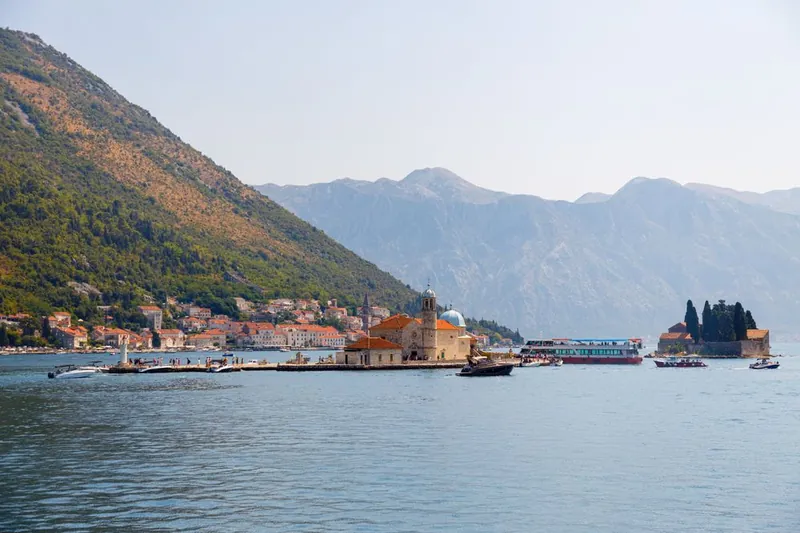
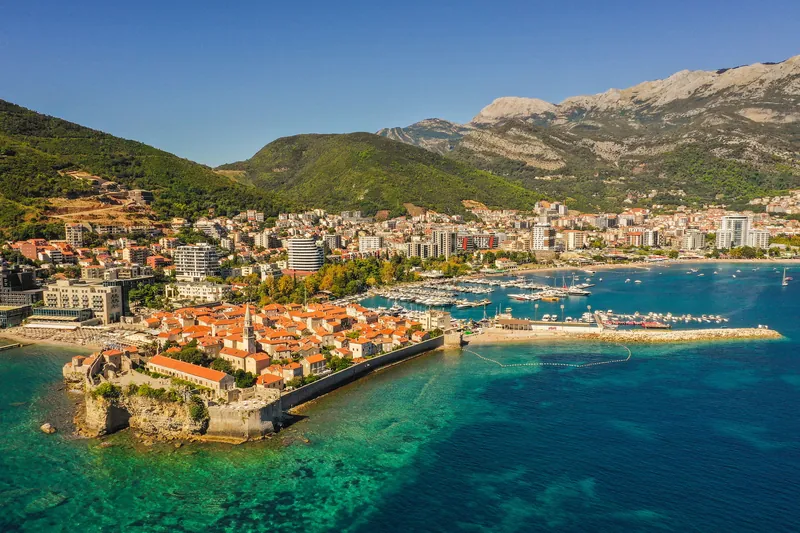
Kotor sits in the middle of the bay, so it pairs naturally with other stops. Twenty minutes along the shore is Perast and Our Lady of the Rocks, the classic half-day pairing. Above the town, the old serpentine road climbs to Lovćen and the Njegoš Mausoleum. And Budva Old Town is around half an hour away if you want a beach afternoon.

Questions people ask
How long do you need in Kotor Old Town?
Two to three hours is enough to walk the old town, see the cathedral and have a coffee on one of the squares. If you want to climb the walls to the fortress of St John, allow half a day. With a private driver, many visitors pair Kotor with Perast for a relaxed half-day or full-day trip around the bay.
Is it worth climbing to the fortress of St John?
Yes, if you are reasonably fit. The path is steep and uneven, and most people take 45 minutes to an hour to reach the top, but the view over the bay is one of the best in Montenegro. In summer go early in the morning or late in the afternoon, take water, and check the current entry fee before you go.
How far is Kotor from Tivat Airport?
About 8 km, or roughly 15 minutes by car when traffic is normal. A private transfer can take you straight from arrivals to your accommodation in or near the old town, with the price agreed in advance.
How do I avoid the cruise ship crowds in Kotor?
Check the port’s published cruise schedule before you choose a day, as some days have several ships in port and others none. On busy days, visit the old town early in the morning or in the late afternoon and evening, when most passengers are back on board, and spend the middle of the day elsewhere around the bay.